Ideas for product teams
Why AI Still Doesn't Understand the Word 'Or' (And Probably Never Will)
Ever asked AI to be 'professional or funny' and got a robotic mess? Discover why a simple human word breaks AI's mathematical brain—and how to fix your prompts.

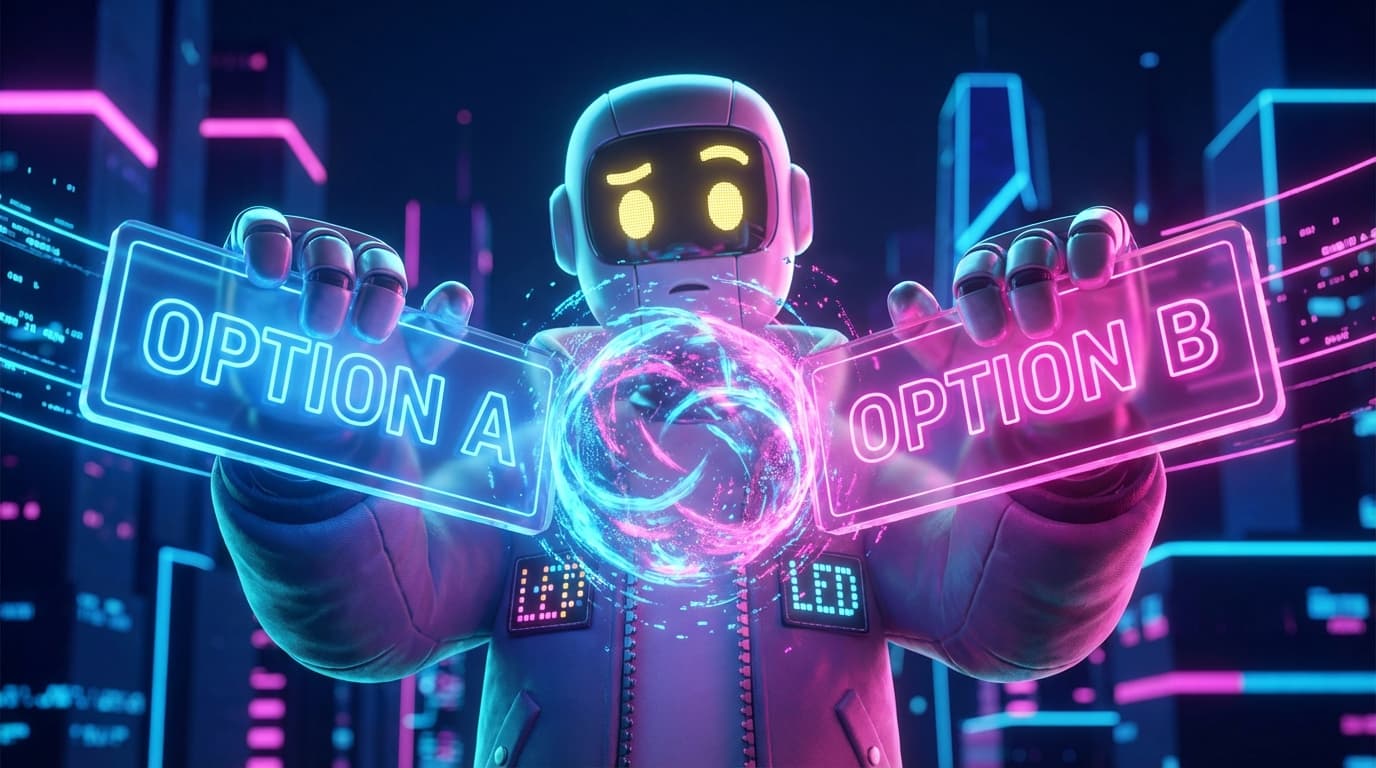
You sit down to write a quick email campaign and tell ChatGPT, "Make it professional or funny." What spits out is a weird, disjointed mess that reads like a robot doing stand-up comedy at a board meeting. You just wanted a simple choice, but the AI completely lost the plot.
The Tiny Word Breaking Your Prompts
Why does this happen? It turns out, the smartest AI models in the world have a massive blind spot when it comes to a tiny, two-letter word: "or."
This collision between messy human linguistics and strict mathematical logic is actively breaking your prompts. It wastes your time and forces you to rewrite things from scratch.
Human English vs. Robot Math
Here is the fascinating reality behind how these tools think. When you ask a human, "Do you want coffee or tea?" they instinctively know you mean one of those options. In everyday English, "or" is an exclusive choice.
But AI is not human. It is built entirely on strict mathematical logic and code. In computer science, "or" (known as an inclusive OR) means "Option A, Option B, or both."
So when you ask an AI to give you a "professional or funny" response, its brain happily tries to give you both at the exact same time. It meshes them together into a confusing, unusable hybrid.
You might ask for a product description that is "short or detailed," and it gives you a weird medium-length paragraph that satisfies neither request. It simply does not understand that humans usually mean "pick one."
4 Ways to Fix Your AI Prompts Today
How do you stop your AI from having an identity crisis? Here are four concrete ways you can adjust your prompts today to get exactly what your business needs:
1. Split your requests into separate prompts Instead of asking for a Facebook ad about your 20% discount or free shipping, ask for two distinct versions. Tell it: "Write one ad focused entirely on the discount, then write a second ad focused entirely on free shipping." You get clear choices instead of a mashed-up mess.
2. Use strict, literal boundaries If you absolutely must give the AI an either/or scenario, spell it out explicitly. You have to tell it not to mix the ingredients. Add a specific instruction that says: "Choose strictly between Option A and Option B. Do not combine them."
3. Assign a clear persona first Tell the AI exactly who it is before giving it choices. If you tell it, "Act like a formal corporate lawyer," it builds a strict set of rules for that persona. If you accidentally use the word "or", the AI's persona will naturally filter out the weird, contrasting options.
4. Replace 'or' with 'if/then' logic AI tools absolutely love conditional logic. Instead of saying, "Write a welcome email or a re-engagement email," give it clear rules. Tell it: "If the customer bought in the last 30 days, write a welcome email. If they have not bought in six months, write a re-engagement email."
Your Next Step
Your realistic first step is simple. Open your favourite AI tool right now and check your standard prompts. Take a prompt you use every week—like a social media post generator or an email drafter—and look for the word "or."
If you spot that tiny word hiding in your instructions, delete it immediately. Force the AI down one specific path first. Review the result, and if it does not work, start a new prompt for the alternative option.
Stop Fighting the Math
AI might never truly understand the messy, beautiful way humans speak. But once you know its mathematical quirks, you can stop fighting it and start getting better results.
Try splitting your next "or" prompt into two separate requests right now. What weird AI quirks have you noticed while running your business? Hit reply and let me know!
Keep my writing close.
Choose Brendan Tack as a preferred source to spot my writing more easily on Google.
Add as preferred sourceOpens Google in a new tab. You choose whether to add me.
What does this do?
This is a personal Google preference, not an email subscription. Google may show more of my writing when it is relevant to your searches. You may need to sign in, then confirm your choice on Google. You can change your preferred sources there at any time.